
The First Year of a New Concrete Curb (and What It Puts Up With)
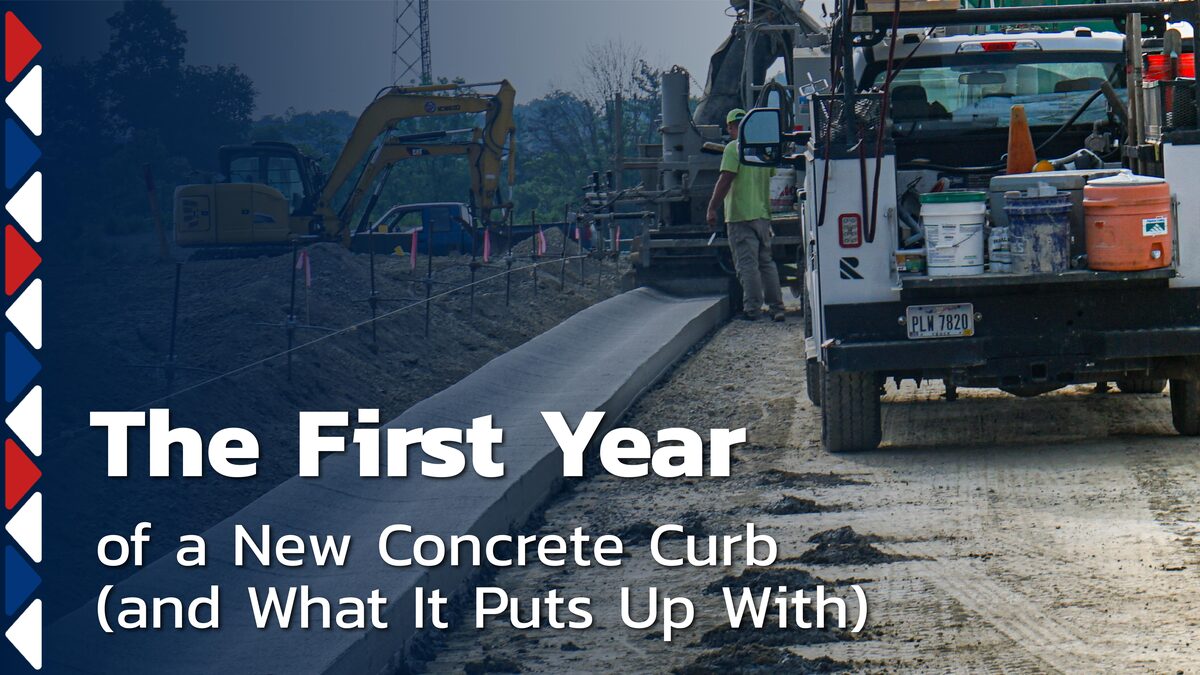
This is a story about a concrete curb. Your budget and a piece of your reputation ride on how it comes through its first year.
Two subdivisions poured new concrete curbing in the same September. The specs matched. So did the winter that followed. By April, one curb has crisp joints and clean edges. The other, with cracks wandering across the face and chips missing along the top, looks like it lost a disagreement.
So, what happened? The winter is off the hook for the damage, because both curbs got the same one. The difference really came from one working day and a handful of decisions that became permanent when the concrete set. Each season exposed another of those decisions. This blog follows that year in order: first weeks, buildout traffic, first winter, spring walk-through.
The First Few Weeks: Strong Enough to Fool You
The clock starts when the forms come off, a day or two after the pour. From then on, the curb looks like every finished curb you’ve ever approved, even though its strength runs weeks behind its looks.
People ask how long concrete lasts and hear answers in decades. Every one of those decades leans on the first few weeks, though. New concrete needs protection while it hardens, a stage the trade calls curing. Even with good curing, concrete holds only 50 to 70 percent of its rated strength after the first week. The full rating comes at 28 days. That weakness is why standard specs keep vehicles off new curb for at least 14 days. So the curb hits peak curb appeal exactly when it can least back it up.
None of that protection happens by accident. Someone picked a mix to fit the season and either laid curing protection down or skipped it. Someone else decided where delivery trucks would drive. After the pour, those calls are closed.
Buildout Season: A Year of Construction Traffic
You already know the paving schedule. Lower layers of asphalt go down early. The final surface course, though, waits until most of the houses are built, usually one to two years later. What that gap means for the curb gets less attention. That is one reason curb and gutter work deserves a hard look before the schedule locks.
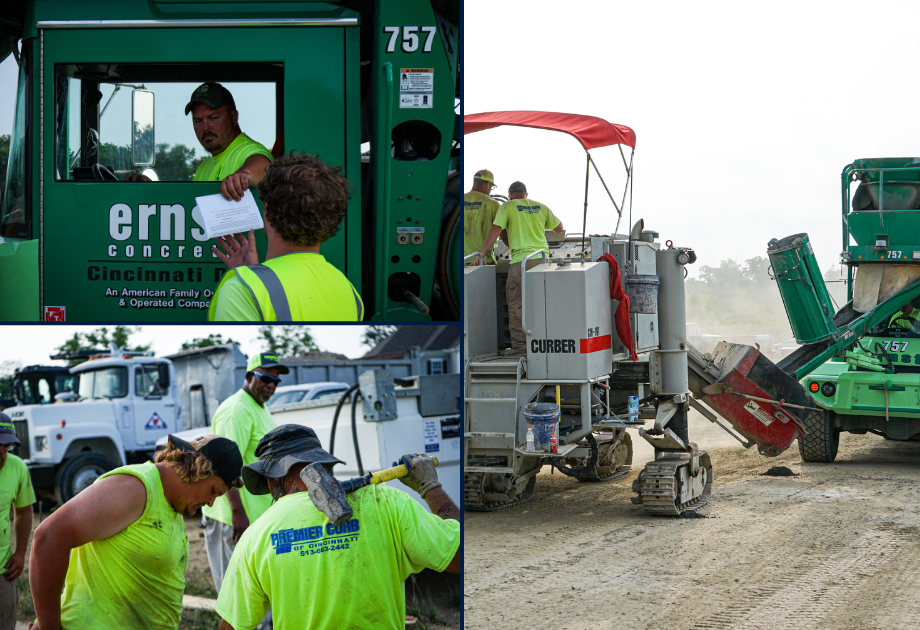
The curb never gets that grace period, because it goes in early and serves as the pavement edging for the entire buildout. Concrete trucks cross it first. Framing crews follow. Then comes every furniture delivery driver who treats the driveway apron as a suggestion.
What carries a curb through that year? The ground under it and the mix inside it. Before pouring, a good crew runs a heavy wheel load over the ground to find soft spots, a step called proof-rolling. A mix built for exterior wear handles the rest. When a crew skips either step, year one gets ugly fast.
The First Freeze-Thaw Season Is the True Test
Then winter shows up and tests everything at once: the mix, the curing, and the finishing. Winter gets that power because concrete soaks up water. When the water freezes, it expands and pushes on the surface from the inside. Good exterior concrete has a built-in answer called air entrainment: tiny bubbles that give freezing water room to expand. Concrete poured without it scaled badly within 2 years, which means the surface flaked away in patches. Concrete poured with it showed none after 7.
Cold weather changes the routine without ending the season. Crews lay insulated blankets over fresh pours to keep the concrete from freezing while it sets. They typically go down mid-November through March. Frozen ground is a harder no. So crews dig through the frost to reach ground it can set on. That work takes experience and a weather-adjusted mix, which is why Charles H. Hamilton pours through most of the winter.
.jpg)
Controlled Cracks vs. Random Cracks
Concrete cracks as it cures, on every pour, no exceptions. The trick, then, is controlling where. Crews cut shallow grooves called contraction joints to give the shrinking concrete a scheduled place to crack. Behind the curb machine, a crew member cuts one every 5 to 10 feet, at spacing the municipality or customer sets. Specs put the depth at a quarter of the concrete's thickness or more. So when spring cracks sit inside the joints, the system worked.
When cracks wander across the face instead, the story changes. The cause list is short: the crew cut the joints too shallow, cut them too late, or poured over soft ground. Winter didn't cause any of those. It just found them.
How the Curb Face Holds Up to a Plow
Every spring, somewhere in Ohio, a plow takes the blame for a crumbling curb. The plow, though, is usually innocent. A properly finished curb face takes a full season of standard blade scraping and stays intact.
So how does a face end up flaking apart in year one? It went soft during finishing, months before the first snow. Troweling is the smoothing pass that gives concrete its finished surface. Too many passes weaken the top layer for good. So does adding water to make the concrete easier to smooth. The plow doesn't create the weak spot. It finds it first.
A plow hitting the curb head-on at speed can damage anyone's concrete. That is an accident. A face crumbling under normal scraping, on the other hand, is a verdict on the finishing.
Spring Walk-Through: Reading the Results
By April, you can read the whole first year in one lap of the site. Three checks cover it. Where did the cracks land? Cracks inside the joints are good news. How does the curb face look? Chipped tops trace back to the trowel. Does the curb still sit level? A curb that heaved or settled is resting on ground nobody compacted. Frost heave is what skipped proof-rolling looks like a year later.
This reading skill pays better in January than in April, because failed curb means replacement, not repair. By then, the sub who poured it collected payment long ago. So run the same evaluation before anyone signs. A pre-pour concrete checklist is the place to start.
Every stretch of new cement curbing looks identical at handoff. That sameness built the old mindset: all curbs look alike, hope for the best. You just spent a full year outgrowing it.
Charles H. Hamilton Pours Curbs That Pass the First Year
The two September curbs never had different winters. They just had different pour days. One crew compacted the ground, called the right mix, cut the joints on time, and left the finish alone. The other cut a corner somewhere on that list. April put the difference on display along a public street.
That display works in your favor when you hire. Decades of Charles H. Hamilton subdivision curb still stand along Southwest Ohio streets you can drive. Premier Curb of Cincinnati pours that work today.
Your next concrete curbing installation faces the same year, one season at a time. Start your project with a team you can trust.