5 Questions That Reveal If Your Curb Subcontractor Will Pass ADA Inspection
5 Questions That Reveal If Your Curb Subcontractor Will Pass ADA Inspection
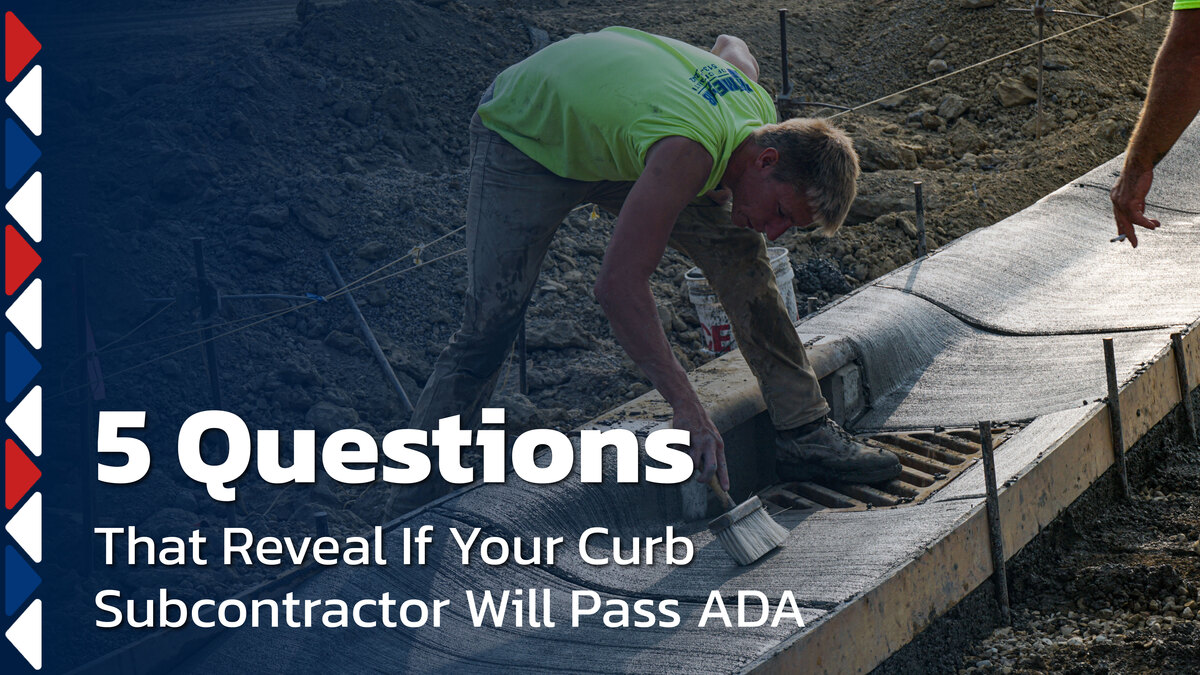
ADA compliance for curb ramps can stall your entire subdivision timeline if your subcontractor doesn't get it right the first time. When a ramp fails inspection, paving can't start, grading can't finish, and municipal approvals freeze. The problem usually isn't that crews don't know ADA standards exist. It's that they measure after they pour instead of verifying before.
The difference between a sub who passes inspection consistently and one who costs you weeks in rework shows up in how they answer specific questions. Here are five questions that reveal whether your curb contractor has a process that works or is just hoping for the best.
1. "How do you verify slopes before you pour?"
This question separates subs who have a real process from those who wing it. ADA tolerances are tight. A ramp measuring 8.5% slope instead of the required 8.33% fails inspection and must be replaced, even though the difference is only 0.17%.
What a good answer sounds like: "We use multi-point measurement across the entire ramp before we form. We check center points, not just edges, and coordinate with the survey crew to confirm elevations match the ADA ramp requirements."
Red flag answer: "We measure after we pour" or "We eyeball it during the pour and check it when we're done."
The problem with measuring after is simple: if the slope is wrong, you're tearing out concrete and starting over. Running slope is the most common ADA failure point because crews check only the edges and miss center deviations. Pre-pour verification catches these issues before they become inspection failures.

2. "Who coordinates with the survey crew on elevations?"
This question reveals whether the sub understands that ADA compliance and drainage design can conflict with each other. Cross-slope (the side-to-side tilt across a ramp) maxes out at 2%. Landings must be flat. But if crews tilt the landing to make water flow, they create a cross-slope violation.
What a good answer sounds like: "We coordinate with surveyors before forming to verify that gutter flowlines and ADA slopes work together. We don't adjust slopes in the field without re-checking compliance."
Red flag answer: "We handle the curb work, the survey crew does their thing" or "We adjust as needed to make drainage work."
When subs adjust slopes on the fly to fix drainage without verifying ADA measurements, they create violations that inspectors catch immediately. Proper slopes, grades, and drainage require coordination between trades, not field adjustments that ignore compliance.
3. "What's your process for checking running slope and cross-slope?"
This question gets at whether the sub knows what inspectors actually measure. Ohio inspectors use levels, measuring tapes, and grade finders to check exact pass/fail thresholds on every curb ramp. Running slope can't exceed 8.33%. Cross-slope can't exceed 2%. There's no construction tolerance built in.
What a good answer sounds like: "We measure multiple points across the ramp, not just the edges. We aim for 7.5-7.7% on running slope during construction to stay safely under the limit. We verify cross-slope before and after pouring."
Red flag answer: "We stay under 10%" or "We get close and the inspector usually passes it."
Inspectors don't "usually pass" ADA work that's out of spec. The Access Board's research on dimensional tolerances makes this clear: ADA elements either meet the criteria or they don't. A slope that's too steep creates a real barrier for wheelchair users, which is why tolerances don't apply.
.jpg)
4. "How do you handle detectable warnings?"
Detectable warnings are the truncated dome surfaces (tactile bumps) required on curb ramps in public rights-of-way and federally funded projects. This is the least common failure point, but it still matters. ADA.gov's standards require that detectable warnings contrast visually with surrounding pavement, be fully integrated into the walking surface, and extend across the full width of the ramp.
What a good answer sounds like: "We install them during the pour, fully integrated. Placement is typically 6-8 inches from the curb face. We don't use surface-applied products."
Red flag answer: "We can add those after if the inspector asks" or "We use the stick-on kind."
Surface-applied detectable warnings don't meet ADA guidelines for most applications. Subs who treat this as an afterthought or optional element don't understand the requirements. Getting it right means knowing placement specs before installation, not adjusting after inspection.
5. "When was the last time you had to redo curb work after inspection?"
This is the honesty test. Every sub has dealt with rework at some point. The question is whether they learned from it and built a process to prevent it, or whether they're still hoping each job turns out fine.
What a good answer sounds like: "We had an issue two years ago where a landing failed cross-slope. That's when we started coordinating with surveyors before forming instead of after. We haven't had a failure since."
Red flag answer: Dodging the question entirely, blaming inspectors for being too picky, or saying "we've never had a problem" (which probably means they don't track it or they're not being straight with you).
Industry data shows that retrofitting ADA issues after the fact costs roughly 5x more than doing it right the first time. One failed inspection means demolition, remobilization, and rescheduling other trades. Understanding how curb and gutter work affects your project schedule helps you see why choosing the right sub matters before work starts.
Work with Premier Curb of Cincinnati for First-Time Pass Reliability
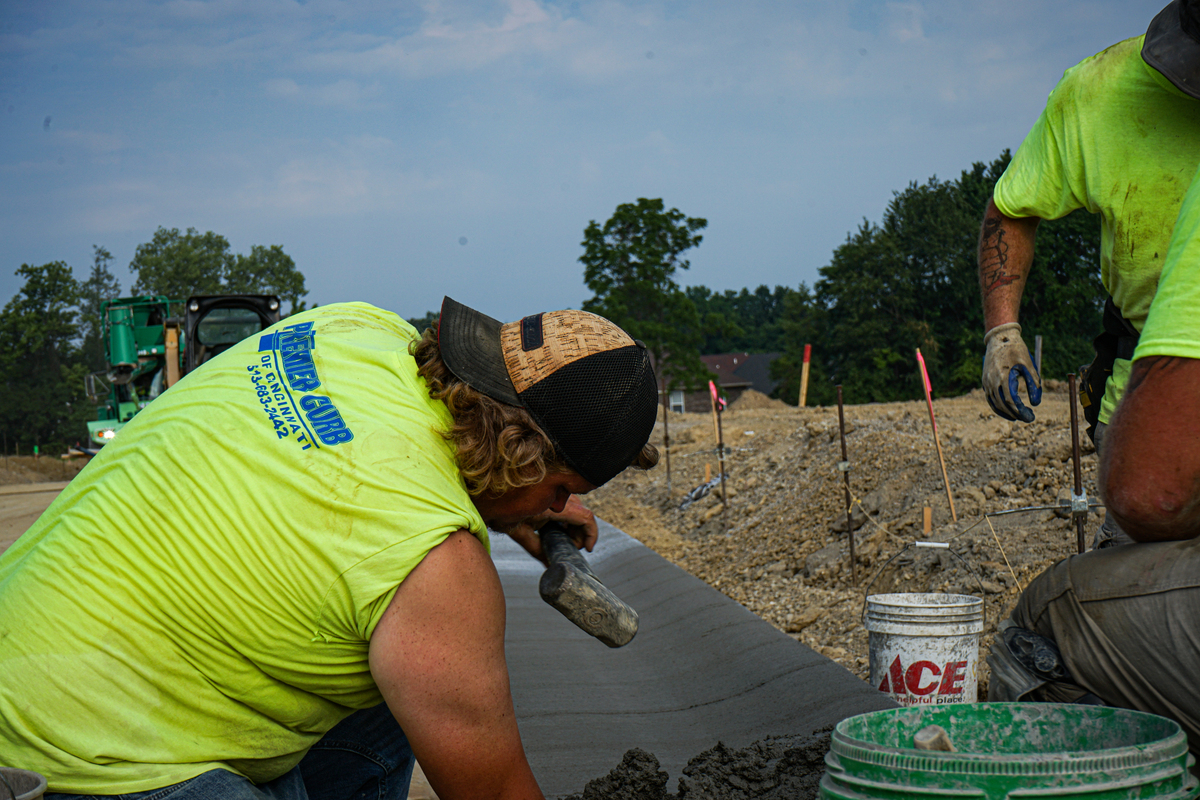
These five questions exist because ADA failures are common and costly. Premier Curb of Cincinnati built our process to answer them the right way. We verify slopes before forming, coordinate with survey crews to handle drainage and ADA requirements together, use multi-point measurement across entire ramps, and maintain communication with inspectors to align expectations before mobilization.
Our experience with ODOT standards and tri-state municipal processes means we know what Ohio inspectors check and how to pass the first time. This is timeline insurance, not premium pricing.
Planning a subdivision project? Contact Premier Curb of Cincinnati and let's discuss how our ADA-compliant process protects your schedule and keeps your development moving forward.